Content Snare vs Clustdoc (2026) - $35 vs $190

Content Snare is the better choice for agencies and accountants who primarily collect documents from clients. It costs less, sets up faster, and the forms are nicer to fill out. Clustdoc wins in regulated industries (financial services, legal, insurance) that need KYC/KYB identity verification and ISO 27001 compliance.
Neither tool covers the whole job: document collection, native e-signatures, payments, and workflow automations in one onboarding flow.
Content Snare is a document collection tool used mainly by agencies and accounting firms. It does one job: get files, information, and content out of clients without the chasing. For a deeper look, read our full Content Snare review. Clustdoc is a client onboarding platform built for regulated industries. Financial services, legal, HR, and insurance firms use it for compliance-heavy intake with identity verification and approval workflows. Our full Clustdoc review covers its strengths and limitations in detail.
This article compares both tools side by side on features, pricing, and setup. We make Portico, which competes with both, so a disclosure sits at the bottom of this page.
Head-to-head comparison
Pricing is current as of May 2026 and sourced from each tool's public pricing page.
| Feature | Content Snare | Clustdoc |
|---|---|---|
| Primary focus | Document and content collection | Client onboarding with compliance |
| Starting price | $35/mo (annual) | $190/mo |
| E-signatures | No | Yes (fields shift in PDFs) |
| Payment collection | No | Yes |
| Conditional logic | Yes | Yes |
| Per-field approve/reject | Yes (core feature) | No |
| Auto-save on forms | Yes | No |
| KYC/AML screening | Yes (ID verification, sanctions checks) | Yes (KYC/KYB with risk scoring) |
| ISO 27001 | Not claimed | Yes |
| Templates | 50 or more | 200 or more |
| Multilingual | No | 10 or more languages |
| Custom domain | No | Paid add-on |
| Client portal | Yes | Yes |
| Automated reminders | Yes (item-specific) | Yes |
| Workflow automations | No | No |
| API | Yes (Zapier) | Yes (unlimited on Expert) |
| Seats included | 2 (Basic) to 20 or more (Custom) | 3 (Pro), 5 or more (Expert) |
| Setup time | Under 1 hour | Days to weeks (at scale) |
| G2 rating | 4.7/5 (54 reviews) | 4.7/5 (61 reviews) |
Where Content Snare wins
Price
Content Snare offers four tiers: Basic ($35/mo annual), Plus ($71/mo), Pro ($119/mo), and Custom ($215 or more). Clustdoc offers three: Pro ($190/mo), Expert (on quote), and Ultimate (on quote). Pro buys 3 user seats and a single onboarding process. A second process means the Expert plan, which is quote-only.
The add-ons widen the gap. Clustdoc charges $389 per custom theme and sells paid "Booster" add-ons for white-label branding and custom domains. If you need document collection and nothing regulatory, that price difference is hard to justify.
Per-field review workflow
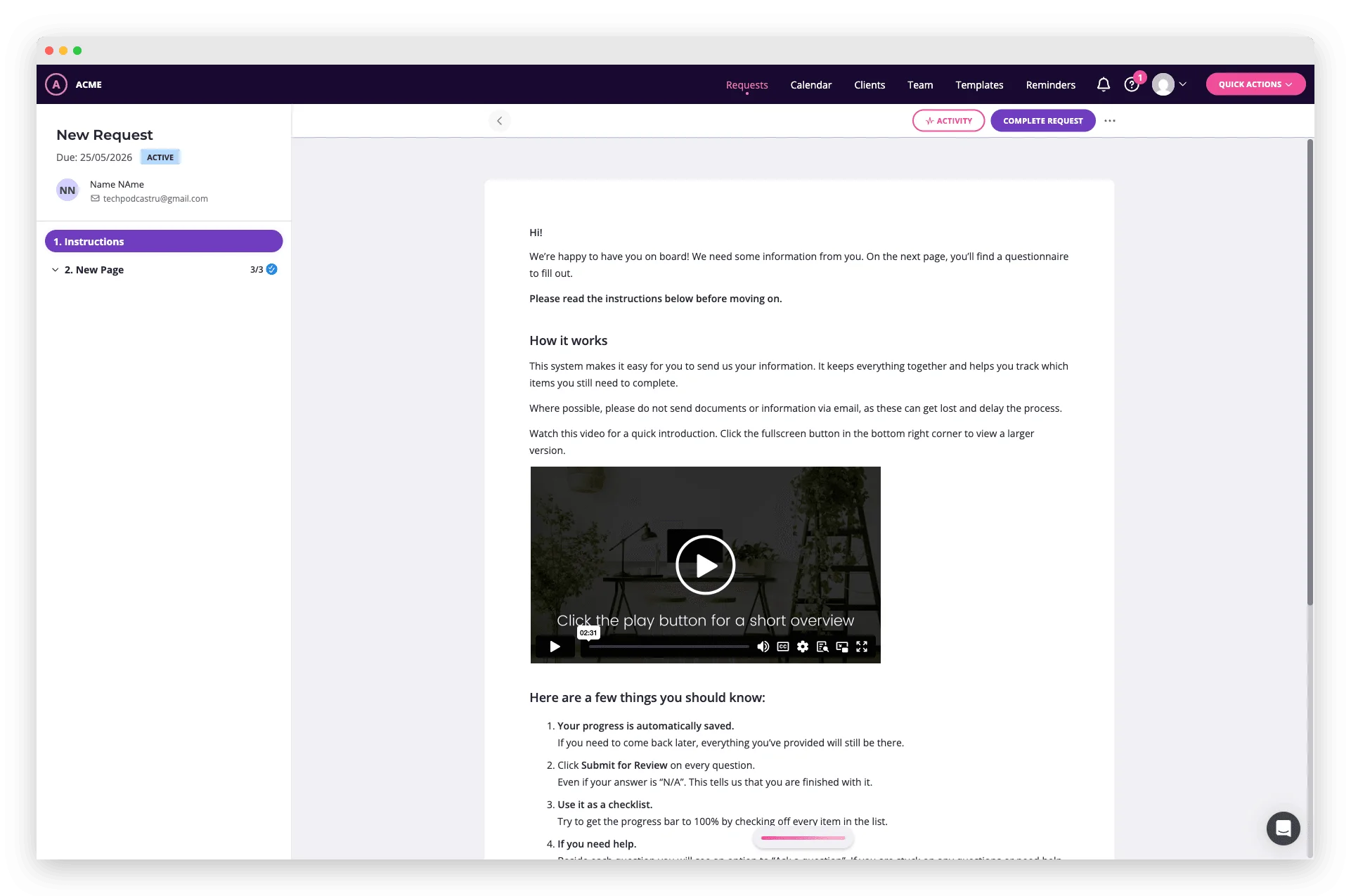
Content Snare's approve/reject system works at the individual field level. Approve an item and it locks from further editing. Reject it and you attach a written note, and the client gets a direct link to the flagged field. Each field shows its status: not started, submitted, approved, or rejected. For accounting firms reviewing tax documents or agencies reviewing creative briefs, that is the end of the email thread. Clustdoc has approval workflows at the application level but does not offer per-field review.
Form experience and auto-save
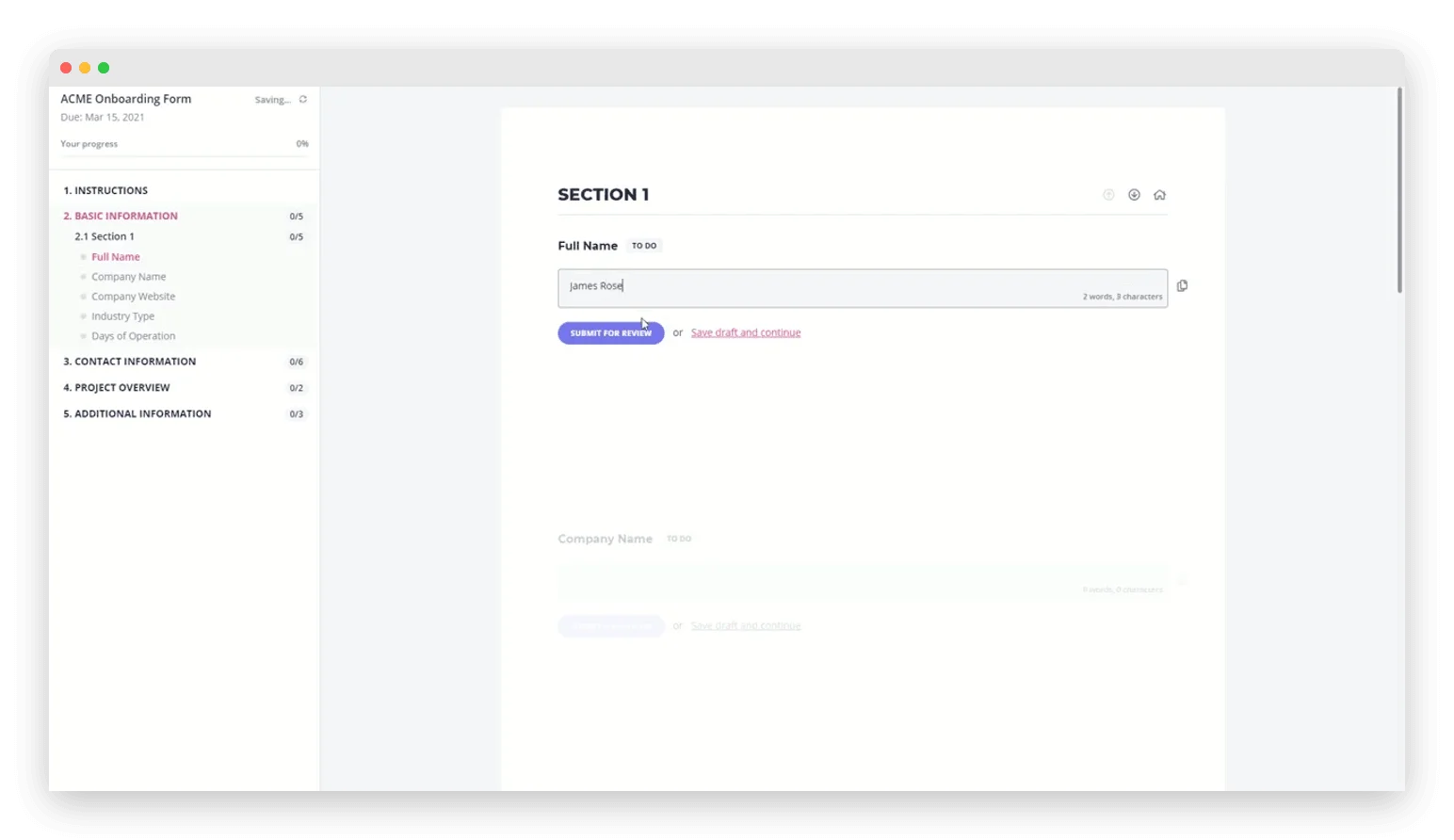
Content Snare's forms include auto-save. Close the browser mid-form and the work is still there. Clustdoc's form builder is consistently described by G2 and Capterra reviewers as outdated. Multiple reviews flag the lack of auto-save and difficulty positioning form fields. One reviewer described the experience as "like the 70s." Nobody asks for auto-save. They notice it the day it is missing and they have to start over.
Setup speed
Content Snare is operational in under an hour for most teams. Its template library covers accounting, agencies, and bookkeeping. Pick a template, change the fields, send it to your first client. Clustdoc's template library is larger (200 or more), and that is not where the time goes. The time goes into multi-step processes with approval chains, conditional tasks, and compliance checkpoints. One attorney configuring 27 process types called the setup "very time consuming." One flow is manageable. At scale, the configuration time compounds.
Where Clustdoc wins
KYC/KYB identity verification
Clustdoc's compliance features are purpose-built for regulated industries. Identity verification, proof-of-address checks, customer risk scoring, and regulatory data retention rules are all native. Content Snare is not empty here. It runs KYC/AML screening with ID document uploads, selfie matching, and checks against sanctions lists and PEP databases. Clustdoc goes further: full KYC/KYB workflows, customer risk scoring, and regulatory data retention tied to individual client profiles. If risk scoring feeds your onboarding decisions, Clustdoc's system is the more complete one.

ISO 27001 certification
Clustdoc holds ISO 27001 certification. Content Snare does not claim this certification on its website. That is a small difference until procurement asks for it. Then it is the whole conversation.
E-signatures and payment collection
Clustdoc includes both e-signatures and payment capture natively. Content Snare has neither natively: signing runs through FuseSign or Annature, and there is no payment step. If clients have to sign an agreement and pay a deposit during intake, Clustdoc does it without a second tool.

One caveat worth noting: multiple Clustdoc reviewers report that e-signature fields shift position in PDF documents. One G2 reviewer in legal services specifically noted that fields are "ALWAYS shifted from the place you put them." Verification codes can also be delayed, and the client feels that delay while trying to sign. Test the PDF workflow before you put a real contract through it.
Multilingual support and template library
Clustdoc supports 10 or more languages for client-facing onboarding. Content Snare is English-only. The interface itself is localized, down to field labels, instructions, and status messages in the client's own language. Clustdoc also offers 200 or more templates compared to Content Snare's 50 or more. Onboard clients across borders and the language support decides this one.
The gap neither tool fills
Neither Content Snare nor Clustdoc combines document collection, native e-signatures, payments, and workflow automations in one onboarding flow.
Look at a normal service business intake. The client fills out a form, uploads identity documents, signs a service agreement, and pays a retainer. Content Snare covers the form and the uploads. Clustdoc covers documents, signatures, and payments. Neither tool chains all four steps into a single guided sequence with conditional logic and automated follow-up. Somebody on your team is the glue.
Content Snare handles collection well but has no native signing (it hands off to FuseSign or Annature) and no payment steps. That means DocuSign and Stripe (or similar tools) bolted on beside it. Clustdoc covers more of the flow, at $190 per month, with documented issues in its form builder and e-signature rendering.
For teams that need the full onboarding flow (forms, documents, signatures, and payments) at SMB pricing, Portico is one option worth evaluating. We compete with both tools, which is why this article includes a disclosure. Our comparison pages for Content Snare and Clustdoc cover the direct Portico matchups.
How to choose
Both tools earn a 4.7 out of 5 on G2 with similar review counts. The rating does not tell you which one fits your workflow. Ratings rarely do.
Choose Content Snare if:
- Your primary need is collecting documents and content from clients
- You do not need e-signatures or payments as part of intake
- You want to spend under $100 per month
- You are an agency or accounting firm
- You need per-field review and approval workflows
Choose Clustdoc if:
- You operate in a regulated industry and need KYC/KYB
- You need ISO 27001 compliance from your vendor
- You process 50 or more applications per month and can justify $190 or more monthly
- You need multilingual onboarding in 10 or more languages
- You need e-signatures and payments in the same tool (with the PDF caveats noted above)
Look elsewhere if:
- You need reliable native e-signatures. Content Snare hands signing to FuseSign or Annature, and Clustdoc's fields shift in PDFs
- You need auto-save on client forms. Clustdoc does not have it
- You want document collection, signatures, payments, and automated reminders in one flow
- You need a modern form builder. Clustdoc's is consistently flagged as outdated by reviewers
For a broader look at the client portal software category, our evaluation guide covers the features that matter and the mistakes to avoid.
Disclosure
Portico competes with both Content Snare and Clustdoc. This article is primarily a comparison between those two tools. Portico is mentioned once as a third option in the section above. We wrote this comparison because no existing content covers this matchup. Our editorial policy applies to all comparison content. All pricing and feature claims are sourced from public pricing pages, product documentation, and third-party review platforms (G2, Capterra).
Frequently Asked Questions
Vlad Kuzin
Founder of Portico. Former content systems architect. Obsessed with removing friction from client workflows.
Onboard your next client with one link
Intake forms, documents, e-signatures, and payments in a single guided flow.
Start FreeNo credit card required. Cancel anytime.